Reposted from Youth Daily News — Report by Sun Chien-Ping / Kaohsiung
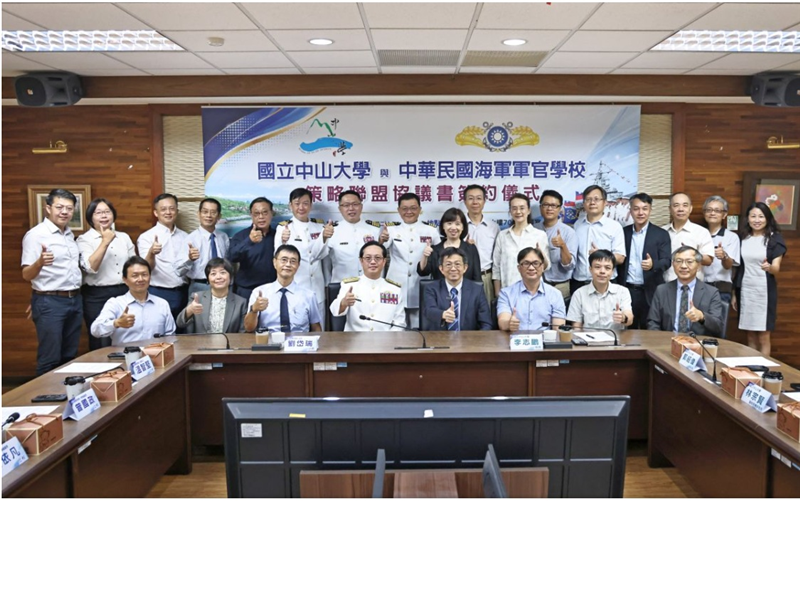
To deepen inter-university cooperation in higher education and promote exchanges between military and civilian universities, the R.O.C. Naval Academy (ROCNA) and National Sun Yat-sen University (NSYSU) renewed their strategic alliance today (18th). The two institutions will integrate knowledge and training across different professional fields to create opportunities and an environment for students to pursue cross-university double majors. In the future, students may earn dual bachelor’s degrees in accordance with relevant academic regulations, cultivating a new generation of professionals who combine national defense expertise with academic and research capabilities, integrate theory with practice, and possess interdisciplinary perspectives.
The signing ceremony was held this morning at NSYSU. In the presence of senior officials from both institutions, Rear Admiral Liu, Superintendent of ROCNA, and President Lee Chih-Peng of NSYSU signed the agreement on behalf of their respective institutions. Superintendent Liu presented NSYSU with the first commemorative gift marking the upcoming 79th anniversary of ROCNA, while President Lee presented the university’s new-generation mascot, the “NSYSU Great Sage Monkey,” symbolizing the continuation of the alliance and the enduring friendship and exchanges between the two institutions.
In his remarks, Superintendent Liu noted that since the two institutions first formed an alliance in 2016, their cooperation has expanded from cross-registration, teaching collaboration, joint faculty appointments, research and development, and the sharing of library and laboratory resources to student clubs, athletics, arts and cultural activities, and international scientific research. Underwater military technology and artificial intelligence have also been identified as key areas of cooperation, further aligning academic research and development with national defense requirements.
Superintendent Liu emphasized that the most significant aspect of the new agreement is the formal inclusion of a provision for the two institutions to jointly promote cross-university minors and double majors for undergraduate students, with detailed regulations to be established separately. This arrangement preserves flexibility and room for future cooperation between the two institutions.
Once supporting mechanisms—including curriculum coordination, credit recognition, student status management, duration of study, military education requirements, and degree conferral—are fully established, the two institutions will be able to formulate corresponding regulations and steadily advance a cross-university dual-degree mechanism. This will enable ROCNA cadets to develop additional interdisciplinary expertise in fields such as marine science, engineering, information technology, and management, in addition to their military education. At the same time, NSYSU students will have greater opportunities to gain insight into maritime security, defense technology, and practical naval operations.
Superintendent Liu expressed his hope that the two institutions will continue to deepen cooperation in three major areas: strengthening exchanges among faculty members, academic programs, and students; focusing on key technologies such as unmanned underwater vehicles, underwater communications and sonar, AI-enabled recognition, and intelligent warfare; and expanding cooperation in marine blue carbon, environmental monitoring, and international scientific research.
By combining NSYSU’s outstanding research capabilities with ROCNA’s military education and practical expertise, the two institutions aim to jointly cultivate a new generation of professionals with expertise, broad perspectives, and leadership capabilities, contributing to indigenous defense technology development, military preparedness, and the sustainable development of Taiwan’s maritime domain.
NSYSU President Lee Chih-Peng also noted that amid the rapid development of artificial intelligence, semiconductors, defense technology, and global industries, interdisciplinary integration, problem-solving, technological application, and teamwork have become essential core competencies for the next generation. The joint talent-development initiative between NSYSU and ROCNA responds directly to emerging trends in higher education and is expected to provide students with more diverse academic pathways.
ROCNA and NSYSU first established their alliance in 2016, focusing on cross-university course enrollment and exchanges among outstanding teaching and research personnel. In 2024, in response to Taiwan’s pursuit of defense self-reliance and technological advancement, the two institutions jointly promoted the integration of underwater military technology and artificial intelligence and established the Taiwan–Palau Marine Science Education Center in Palau, further deepening cooperation in talent cultivation and scientific research.
In 2025, ROCNA and NSYSU further joined the National Chung-Shan Institute of Science and Technology (NCSIST) and two other universities to establish the Underwater Unmanned Technology Strategic Alliance, bringing together the capabilities of academia, research institutions, and industry to advance underwater unmanned technologies.